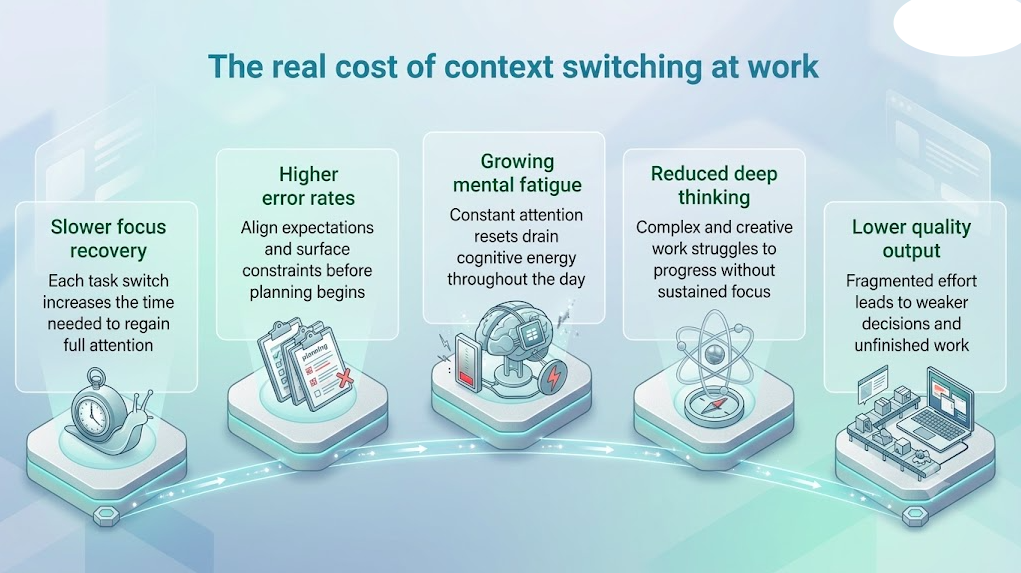
The average employee does not have a productivity problem, they have an attention problem.
Workdays are increasingly fragmented by emails, meetings, chat messages, dashboards, spreadsheets, project management tools, and endless notifications. Employees jump between applications, switch priorities constantly, and spend valuable time trying to reconnect with information they were working on moments earlier.
The result is familiar to leaders everywhere:
Slow decisions.
Lost context.
Duplicated work.
Constant interruptions.
And teams that feel busy all day without making meaningful progress.
Research from the University of California, Irvine, found that it can take more than 20 minutes for people to fully regain focus after an interruption. Multiply that across dozens of interruptions each day, and the hidden cost of context switching becomes enormous.
As organizations grow, this challenge becomes even more complex. Workflows span multiple systems, information lives in different places, and employees spend increasing amounts of time coordinating work rather than doing the work itself.
Artificial intelligence is changing that.
AI is becoming an operational layer that helps teams consolidate information, automate repetitive coordination, maintain continuity across tasks, and reduce the cognitive load created by fragmented work environments. Rather than forcing people to constantly switch between tools and contexts, AI enables work to flow with greater clarity, speed, and consistency.
At Zerem.ai, we work with leadership teams to reduce operational friction by embedding AI into everyday workflows. Our focus is not simply deploying tools. We design systems that help people spend less time searching, switching, and reacting, and more time executing high-value work.
In this blog, we will:
Explain why context switching has become a major productivity challenge
Present current research on interruptions and fragmented work
Identify the primary causes of context switching
Explore how AI reduces workflow friction
Outline a structured framework for reducing context switching at scale
Show how Zerem.ai helps organizations build focus-oriented operations
Recent research shows that context switching has become one of the largest hidden barriers to productivity.
According to Microsoft’s 2025 Work Trend Index, employees are interrupted approximately every two minutes during core work hours. These interruptions come from emails, chats, meetings, and notifications, resulting in roughly 275 interruptions per day.
The same research found that communication activities consume around 60% of the average workday, leaving only 40% available for focused work and higher-value tasks. This creates what Microsoft calls the “Infinite Workday,” where constant interruptions make deep work increasingly difficult.
Atlassian’s 2025 State of Teams research, based on a survey of 12,000 knowledge workers and 200 executives, found that employees spend 25% of their time searching for information.
Knowledge workers frequently switch between tools and repositories to locate documents, updates, and context. This constant searching delays execution and creates unnecessary cognitive load.
Organizations with stronger knowledge-sharing systems and AI-enabled collaboration experience greater efficiency because employees spend less time hunting for information and more time executing work.
Research published by Atlassian in 2026 found that:
68% of developers
70% of managers
save 10 or more hours per week with AI tools.
At the same time, 50% of developers report losing 10 or more hours each week because of fragmented tools, poor information access, and constant context switching.
These findings show that AI alone does not eliminate productivity challenges. Organizations also need integrated workflows and connected systems to capture the full benefits of AI.
Microsoft’s 2025 Work Trend Index found that:
53% of leaders say productivity must increase.
80% of employees and leaders report lacking sufficient time or energy to complete their work effectively.
This gap between rising expectations and limited human capacity places additional pressure on employees. Frequent task switching compounds this problem by increasing mental fatigue and reducing opportunities for focused work.
Recent workplace research shows that the average employee now receives:
117 emails per day
153 Teams messages per day
Employees are interrupted every two minutes, creating a communication environment that fragments attention throughout the day.
The study also estimates that unproductive meetings cost businesses approximately $399 billion annually, demonstrating the scale of coordination inefficiencies created by modern work patterns.
According to new research from Glean’s Work AI Institute involving 6,000 full-time workers across the United States, United Kingdom, and Australia, 87% of employees already use AI at work, and 75% report increased personal productivity.
Despite these gains, only 13% believe their organizations are performing significantly better overall.
The study found that knowledge workers spend an average of 6.4 hours every week managing AI outputs, correcting responses, and supplying additional context. Employees who spend excessive time performing this “botsitting” work are 73% more likely to consider leaving their jobs.
These findings demonstrate that AI adoption without workflow design can simply replace one form of context switching with another.
Reducing context switching begins with understanding where it originates.
Common causes include:
Employees frequently move between:
Chat platforms
Project management tools
CRM systems
Documents
Dashboards
Meeting platforms
Every transition requires mental reorientation.
Incoming messages, alerts, and meetings interrupt concentration and fragment attention.
Employees spend considerable time searching for:
Documents
Historical conversations
Reports
Previous decisions
Customer information
Knowledge becomes scattered across systems.
Manual updates, reporting, copy-pasting, and status tracking create unnecessary interruptions.
Disconnected tools require people to act as intermediaries between systems, increasing cognitive load.
AI creates value by reducing the number of decisions, searches, and transitions employees perform throughout the day.
AI can surface:
Relevant documents
Historical conversations
Meeting summaries
Customer histories
Knowledge base articles
Employees spend less time searching and more time executing.
AI can:
Aggregate data
Generate summaries
Build dashboards
Highlight anomalies
Managers spend less time compiling information manually.
AI assistants can:
Capture discussions
Generate notes
Identify decisions
Assign tasks
This reduces post-meeting administrative overhead.
AI coordinates tasks across systems by:
Triggering updates
Routing approvals
Sending reminders
Surfacing risks
Teams spend less time managing processes manually.
AI memory capabilities help maintain continuity across workflows, reducing the need to repeatedly reconstruct information.
AI-generated:
Strategic briefs
KPI summaries
Risk alerts
Board reporting
AI-supported:
Prospect research
CRM updates
Pipeline prioritization
Meeting preparation
AI enables:
Campaign summaries
Competitive analysis
Content ideation
Audience insights
AI improves:
Bottleneck detection
Workflow monitoring
KPI visibility
Exception handling
AI assists with:
Policy summarization
Employee feedback analysis
Onboarding documentation
Training materials
AI supports:
Forecasting
Variance analysis
Reporting automation
Scenario planning
When AI is integrated into workflows, teams spend less time switching contexts and more time making decisions.
Reducing context switching requires more than introducing new tools. Organizations that succeed redesign workflows around attention, clarity, and execution.
At Zerem.ai, we implement a structured framework that transforms fragmented work into intelligent, integrated operations:
Align → Automate → Achieve
This model enables organizations to reduce cognitive load while improving productivity and decision quality.
Before introducing automation, organizations must understand where context switching is occurring and why.
This phase answers a foundational question:
Where is fragmented work creating friction, and how should AI improve focus and execution?
Core Objectives of the Align Phase
Identify sources of attention fragmentation
Connect AI initiatives to measurable productivity outcomes
Clarify ownership and accountability
Map workflow bottlenecks
Establish governance and data controls
Key Activities
1. Define Productivity Outcomes
Leadership identifies metrics AI should improve, such as:
Reduced interruption frequency
Faster decision cycles
Increased throughput
Lower administrative workload
Improved reporting speed
These become the success metrics for workflow optimization.
2. Workflow Friction Audit
Teams document:
Frequent tool switching
Manual copy-paste work
Reporting bottlenecks
Meeting overload
Information retrieval delays
This reveals where AI can create leverage.
3. Stakeholder Interviews
Executives, managers, and employees surface:
Operational pain points
Productivity barriers
Collaboration challenges
Workflow inefficiencies
Tool fatigue
This ensures AI deployment aligns with actual work patterns.
4. Governance & Tool Strategy
Organizations define:
Approved AI platforms
Data privacy standards
Human review requirements
Access permissions
Escalation procedures
Governance creates confidence and consistency.
Department-Specific Alignment
Executive Leadership
Performance summaries
Strategic visibility
Risk monitoring
Sales
Deal intelligence
CRM workflow optimization
Prospect insights
Marketing
Content workflows
Campaign reporting
Market intelligence
Operations
Bottleneck analysis
Task orchestration
KPI visibility
Human Resources
Policy interpretation
Documentation support
Employee insights
Finance
Reporting automation
Forecast preparation
Data consolidation
By the end of the Align phase, organizations understand:
Where attention is being lost
Which workflows create the most friction
How AI will improve productivity
What success looks like
Exploration shifts into structured readiness.
Once alignment is established, organizations move into execution.
Automation focuses on preserving focus and reducing unnecessary interruptions.
Core Objectives of the Automate Phase
Convert fragmented processes into AI-assisted workflows
Reduce tool switching
Improve workflow continuity
Strengthen reliability and trust
Key Actions
1. Workflow Translation
Processes are redesigned into AI-supported flows:
Collect → Analyze → Summarize → Review → Execute
Monitor → Detect → Recommend → Approve → Implement
AI becomes part of existing systems rather than another destination.
2. Controlled Automation Enablement
AI systems are configured to:
Generate summaries
Route information automatically
Trigger updates
Surface anomalies
Coordinate tasks
Human oversight remains intact.
3. Operational Integration
AI becomes embedded into:
Daily reporting
SOPs
Project management systems
Dashboards
Review cycles
AI functions as part of work rather than an additional task.
4. Training & Enablement
Employees learn to:
Delegate repetitive tasks
Evaluate outputs
Refine prompts
Manage exceptions
Maintain accountability
Confidence develops through repetition and structured usage.
What Automation Enables at the Executive Level
As automation matures, organizations observe:
Fewer interruptions
Reduced administrative work
Better focus
Greater consistency
Improved output quality
The Achieve phase transforms workflow improvements into sustainable operating capability.
Core Objectives of the Achieve Phase
Measure productivity improvements
Scale successful workflows
Strengthen governance
Institutionalize focus-oriented work
Key Moves
1. Performance Measurement
Organizations track:
Time saved
Cycle time reduction
AI adoption rates
Reporting efficiency
Output quality
Employee satisfaction
These metrics validate ROI.
2. Scaling Rollout
Successful workflows expand to:
Additional departments
More complex processes
Cross-functional coordination
Scaling remains structured and measurable.
3. Governance Maturation
As confidence increases:
Permissions evolve
Oversight mechanisms strengthen
Policies mature
Accountability becomes more visible
4. Cultural Integration
AI becomes:
Part of onboarding
Embedded in leadership expectations
Included in performance discussions
Recognized as a standard operating capability
Focus becomes part of organizational culture.
Organizations reduce context switching when:
Workflows are clearly defined
Information is centralized
AI removes repetitive coordination
Governance reduces uncertainty
Productivity outcomes are measurable
The Align → Automate → Achieve framework enables organizations to transform fragmented work into focused execution.
At Zerem.ai, we apply this model to help leadership teams build operations that strengthen attention, improve decision quality, and increase productivity across the enterprise.
Context switching has become one of the largest hidden barriers to productivity. As organizations grow more digital, reducing workflow fragmentation becomes essential for sustained performance.
Organizations that redesign work around AI and intelligent systems experience:
Greater focus
Faster decisions
Reduced cognitive load
Higher productivity
Better employee experience
Improved execution quality
At Zerem.ai, we help organizations build focus-driven operations where AI supports people, workflows reinforce clarity, and productivity scales sustainably.
If you want to explore how AI can help your teams reduce context switching and improve productivity, book your Complimentary 30-Minute AI Strategy Session with Zerem.ai today.
