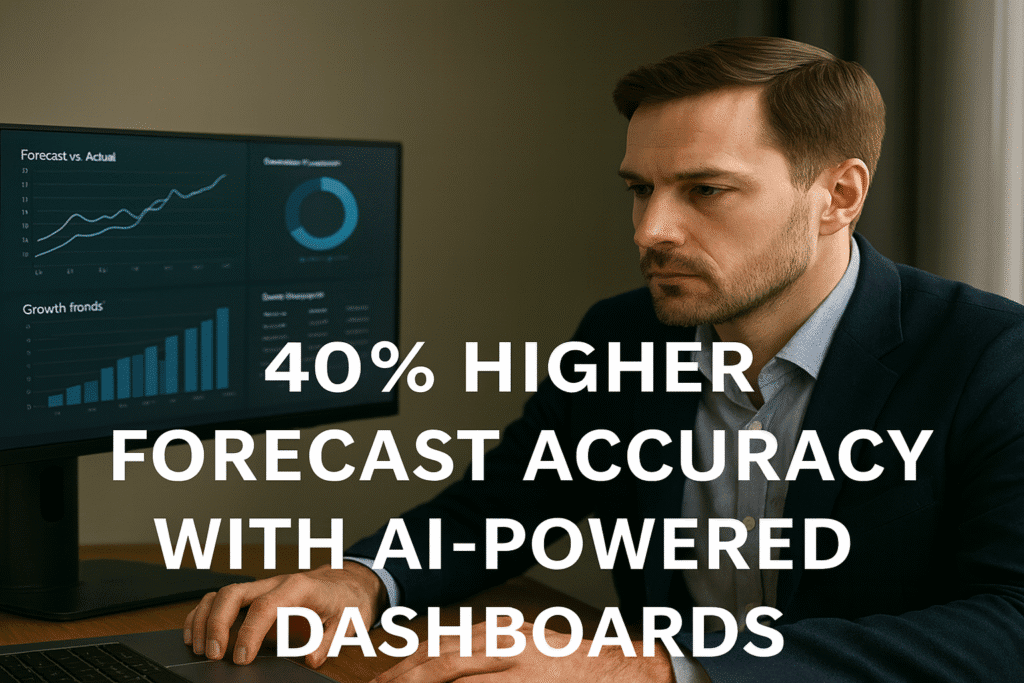
Let’s be honest: most dashboards look like they’re working.
They’re filled with charts, they auto-refresh every hour, and every team has access. Marketing tracks campaign performance. Sales tracks pipeline. Finance monitors profit margin.
But when it’s time to make a decision?
What is your process? Do you have one? That’s often when things fall apart.
Marketing claims pipeline is up 20%.
Sales insists opportunities have stalled.
Finance warns CAC is creeping up.
Each team has data. Each team has a view.
And yet—it’s challenging to get agreement on what’s happened and what to do about it.
So whose dashboard do you trust when revenue is on the line?
This isn’t a UI problem. Or a data visualization problem.
It’s a systems problem—and it’s costing companies millions
According to Gartner, 74% of executives don’t fully trust their dashboards.
Forrester reports that 20–30% of growth is lost each year due to decisions made on misaligned or delayed insights.
This happens because most dashboards are built without the technical backbone required for consistency and trust.
They display metrics—but lack system-level integrity.
Common failures include:
So while the charts may look polished, the underlying data is often fragmented, inaccurate, or misinterpreted.
Dashboards aren’t the problem. The issue lies in the questionable data and disconnected context behind them.
What exactly is a “conversion”?
Even if the numbers are accurate, they’re not comparable.
So dashboards refresh in real-time—but the teams reading them are interpreting them differently.
Without shared definitions and a unified KPI map, dashboards fuel confusion—not clarity.
Dashboards don’t fix bad data. They just display it more beautifully—and more often.
We see it all the time:
With automation, these errors don’t just sit still—they get updated, pushed, and surfaced repeatedly.
Leaders sense the chaos. And gradually, they stop trusting the dashboards altogether.
Dashboards might update in real time.
But decisions happen on a daily, weekly, or monthly rhythm—depending on the role.
When dashboards don’t reflect that cadence, they become irrelevant in the moments that matter most.
Even when a dashboard shows something’s off—nothing happens.
Why?
Because most dashboards stop at visibility. They show the “what,” but not the “so what.”
Without a feedback loop, dashboards become static. They can flag issues—but they can’t resolve them.
And that’s where AI and automation come in.
Yes, tools like HubSpot, DashThis, and AgencyAnalytics make dashboards easier to build.
But easier doesn’t mean better.
A dashboard is only as good as the system around it.
Automation doesn’t replace alignment. It amplifies whatever alignment—or misalignment—already exists.
What teams actually need isn’t another dashboard—it’s a system that aligns teams, interprets data, and connects insights to action.
And that’s exactly what we’ve built.
At Align, we transform dashboards from passive reports into active, role-specific, AI-powered decision systems.
Here’s how:
We don’t start with dashboards—we start with business outcomes.
That means aligning KPIs across teams around what actually drives growth:
Then ensuring alignment around whether it’s a Key Performance Indicator (KPI) or Metric, the calculation and how often it will be tracked and what actions will impact it.
AI then reviews it all to ensure it’s the best it can be.

But good metrics aren’t enough—they need to surface where decisions are made.
We embed dashboards into structured meeting rhythms and agendas:
These meetings exist to:
When dashboards follow your operating rhythm, they stop just reporting—and start guiding decisions.
 (Aligncoach.ai: Meeting Rhythms & Agenda Presentation)
Even with the right metrics, your dashboards are only as good as the data beneath them.
Our AI automation teamI—creates systems that cleans, deduplicates, and standardizes data across tools. That includes:
This process ensures that the data teams see is consistent, contextual, and reliable—so leaders can act with confidence.
Dashboards are tailored to how people work—not just what they view. We personalize insights by role, function, and workflow rhythm:
Reps use daily dashboards to prioritize deals and leads in real-time

(Source: https://aligncoach.ai/)
These dashboards aren’t static—they adapt as team priorities shift. Powered by AI, they continuously surface the most relevant insights, ensuring decision-makers get the right view at the right time.
This is where traditional dashboards stop—and Align goes further.
Every insight surfaces real, trackable next steps:
With predictive AI, Align transforms static insights into real-time, automated action—so no opportunity is missed.

To achieve a 97% success rate our framework is powered by a hands-on team of 4 roles:

(Source: https://aligncoach.ai/)
We’re not another analytics agency.
We’re AI System Architects for companies who need their data to drive results—not debate.
When dashboards aren’t part of a system, here’s what gets lost:
❌ 40% of planning time wasted aligning numbers
❌ Missed signals buried in cluttered charts
❌ Gut-feel decisions when clarity is missing
❌ Dashboards are abandoned altogether
With Align, you get:
✅ 10–20 hours/week saved from manual reporting
✅ ~28% reduction in rework during planning cycles
✅ 2.4x faster decision cycles in sales and ops
✅ 90%+ dashboard adoption across departments
Dashboards alone don’t drive growth.
AI Systems do.
If your dashboards feel like they’re creating noise instead of clarity—it’s not the design.
It’s the lack of a system underneath.
When you connect clean data, aligned KPIs, decision-specific views, and AI-powered action, your dashboards stop looking pretty and start driving real results.

To align growth, smarter systems, and dashboards that finally deliver clarity,
—The AlignCoachAI.com Team